Showing posts with label gratitude. Show all posts

Wednesday, December 8, 2021

land acknowledgement: an embodied practice


I wake up at dark early and do my routine. I set the kettle to boil, get tea ready.

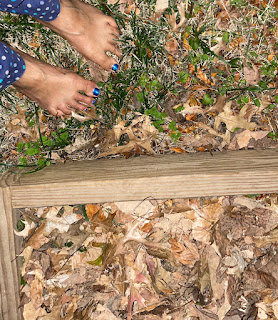
I go outside then step off the porch to stand barefoot next to my first garden bed. I begin my gratitudes: thank you Earth for my life, thank you for my daughters, garden, family, friends; I go on and on, listing. I thank the cardinal flowers for the hummingbirds that love them, the parsley for hosting swallowtails. I inhale and exhale deeply, mindful of my dependence of clean fresh breath for vitality. 

I thank the wind for blowing, welcome its caress. If I hear birds, I thank them for their song, a different sort of caress. I thank each season for the gifts unique to it. I thank the dark for what it brings to light. I thank the trees next door, across the street; the ones I have daily relationship with. I thank the stars, moon and clouds, whatever is in view at the moment. 

Sometimes it is so cold, I do this fastly. Sometimes I linger. Either way, I breathe and root my feet into my Mother, kiss the ground through my soles, yes through my soul, to feel Her embrace. I ponder the thousands of species that have slithered, crawled, flitted, flown, climbed right here through the centuries. I recognize my eventual return to Her. Gratitude wells up for what She provides; indeed for Her divine and dependable abundance for all beings. She is home.

I wake up at dark early to practice a new routine.  

In this daily ritual I acknowledge the trauma of settler colonialism; acknowledge the ingrained paradigm of  supremacist capitalism within myself; acknowledge our capacity for direct relationship with Earth, our birthright as humans-from the Latin, humus, meaning Earth. 

It is simply not enough to acknowledge the past here on this continent while globally, presently, Indigenous peoples are increasingly threatened by extractive capitalism. As the number of Indigenous defenders murdered rises yearly, as globalization interferes with more Indigenous cultures in their symbiotic relationship with Earth, we must take land acknowledgement into the present and future tenses as well as into our own past tense; we must embody it.

We too, once upon a time, were indigenous to a land, a culture, a people that understood ourselves as of the land which sustained us. I want to remember what was hardwired into my being centuries ago. When I stand barefoot in the midwest, I imagine a blood ancestor barefoot in the mideast also paying homage to our divine Mother; I imagine other ancestors who may have stood on this very spot to pay homage, a chorus across time, geography, and lineage. A chorus that undoes the distance-and delusions-of supremacy, colonialism and capitalism. The delusions that keep us from right relationship with Earth.

A line from ee cummings comes to mind, "here is the deepest secret nobody knows..."

And yet we do know. The land upon which I live doesn't belong to me. Just as the squirrels nesting in the honey locust next door don't own the tree. That is a capitalist approach to Earth. By acknowledging, instead, we belong to Her, we recognize the covenantal relationship at the heart of belonging. To make acknowledgement be about ownership is sacrilege, like pinning a swallowtail to a board. Let us emancipate acknowledgement from the performative gesture of colonizers. 

I wake up at dark early to embody a new routine.  

When I finish my gratitudes, I become quiet; offering silence, listening, as hospitality, as space for the deepest secrets, my own Indigenous relationship with Earth, to sing within my blood. Yes we do know. Those sacred routines are dormant within us, waiting to be acknowledged. 

Friday, December 19, 2014

practicing gratitude

Growing up Thanksgiving was a big deal. Each year, we would have at least five or six families over. Extensions went into the dining room table and even the Ping-Pong table was dragged out to accommodate everyone. Being immigrants, we were grateful for the life this country allowed us to create. My family channeled this gratitude into lavish Thanksgiving decorations and an extravagant spread.

I never thought about the environmental cost of these celebrations.

In my Halloween post I suggested selecting a category to green up: decorations, costumes or treats. The same applies for Thanksgiving. Pick one category, then next year or even Christmas, expand to include another. For Thanksgiving, the environmental toll comes from waste and food. Obviously traveling takes an environmental toll but if that’s nonnegotiable, here are things you can control.

WASTE

 Between Thanksgiving and New Year's, Americans produce an extra 5 million tons of household waste each year including three times as much food waste as other times of the year.

What can you do about that?

1. Before purchasing anything new, particularly if it’s just for a holiday event, ask yourself if you really need it and if so, can you borrow or get it used? Encased in wasteful packaging, new items consume resources and fossil fuels to manufacture and ship.

2. Buy in bulk. Shop at stores that have dispenser bins from which you take what you need and eliminate unnecessary packaging. If you take your own bags-cereal box sleeves, bread bags-that’s even less wasteful.

3. Use real plates. Although it seems like a hassle to wash dishes, doing this chore with a friend or relative rarely seen is an opportunity to connect. To this day I have a deep affection for one of my mom’s friends because we always did the Thanksgiving dishes together. Besides, you’ve just expended time and effort cooking something delicious. Don’t dishonor it by putting it on a disposable plate.

4. Use real napkins. I’m not giving stats on how wasteful it is to use trees as napkins. Consider this instead. We’ve just spent the last month or so admiring fall trees. Why would we then want to destroy them to wipe our mouths? You know they absorb carbon and produce oxygen, right? Seems like we ought to practice gratitude for trees by letting them do their beautiful, live giving work. It’s worth a little extra laundry.

5. While preparing for the big day, enlist your children to create recycling stations. Assign them the important job of making sure things end up in the right bins.

6. If you buy food in plastic or glass containers, wash and save them for giving away leftovers. You can also ask your guests to bring their own reusable containers. That way you’re not wrapping leftovers in foil or plastic wrap, which end up in a landfill.

7. Reuse your kids’ artwork. Have them repurpose it into place cards and decorations (unless you’ve already buried it in the recycle bin).

8. You know neither plastic nor paper is a good choice as the store, right? And you know you can take your own bag into any store, not just the grocery? And by the way, when you buy produce, you don’t need to put it in plastic bags. Those apples or whatevers can go directly into your cart, eliminating even more waste.


FOOD

9. Most food travels hundreds of miles to get to grocery stores, gobbling up fossil fuels. Instead seek local sources for your holiday meal. KC Food Circle is the yellow pages of area farmers, detailing what and where they sell. It’s a satisfying experience to purchase from a farmer at market or directly from their farm than to deal with grocery store craziness. Besides, farm fresh anything tastes SO much better.

10. Americans throw away 40% of the food they purchase. Plan your menu carefully so that you’re accounting for volume of food per number of guests. Love Food, Hate Waste has a helpful planning guide so you buy just what you need. It also provides creative recipes for leftovers.

11. If you use smaller plates, guests are less likely to overload them. If they want more they can go back but uneaten food left on a plate will likely be discarded. Also, pay attention to how high the littles pile their plates compared to what they actually eat.

12. Most uneaten food can be composted. If you don’t compost, ask a friend or neighbor if you can contribute to their compost. Several neighbors add to our pile regularly. If that’s not an option, check out Bad Seed, which offers composting at their market. You could inquire about adding your scraps to community or school garden compost piles.


As a kid, it didn’t occur to me to consider where everything-decorations, floral bouquets, food-came from, how it got to our house or what happened to it after we were done with it. But as an adult I am becoming more mindful of the trajectory of materials beyond my point of contact. After all, everything we have, including our health, comes from the earth. Since Thanksgiving is a time to express gratitude for what we have, shouldn’t we also pay attention to how that expression of gratitude is manifest? Taking care of the planet that sustains us is a practice in gratitude.

 I've moved!  Please visit me at   https://www.marysilwance.com /